How Data Architecture and Asset Management Drive AI Transformation
Why Data Architecture is the Backbone of AI Success
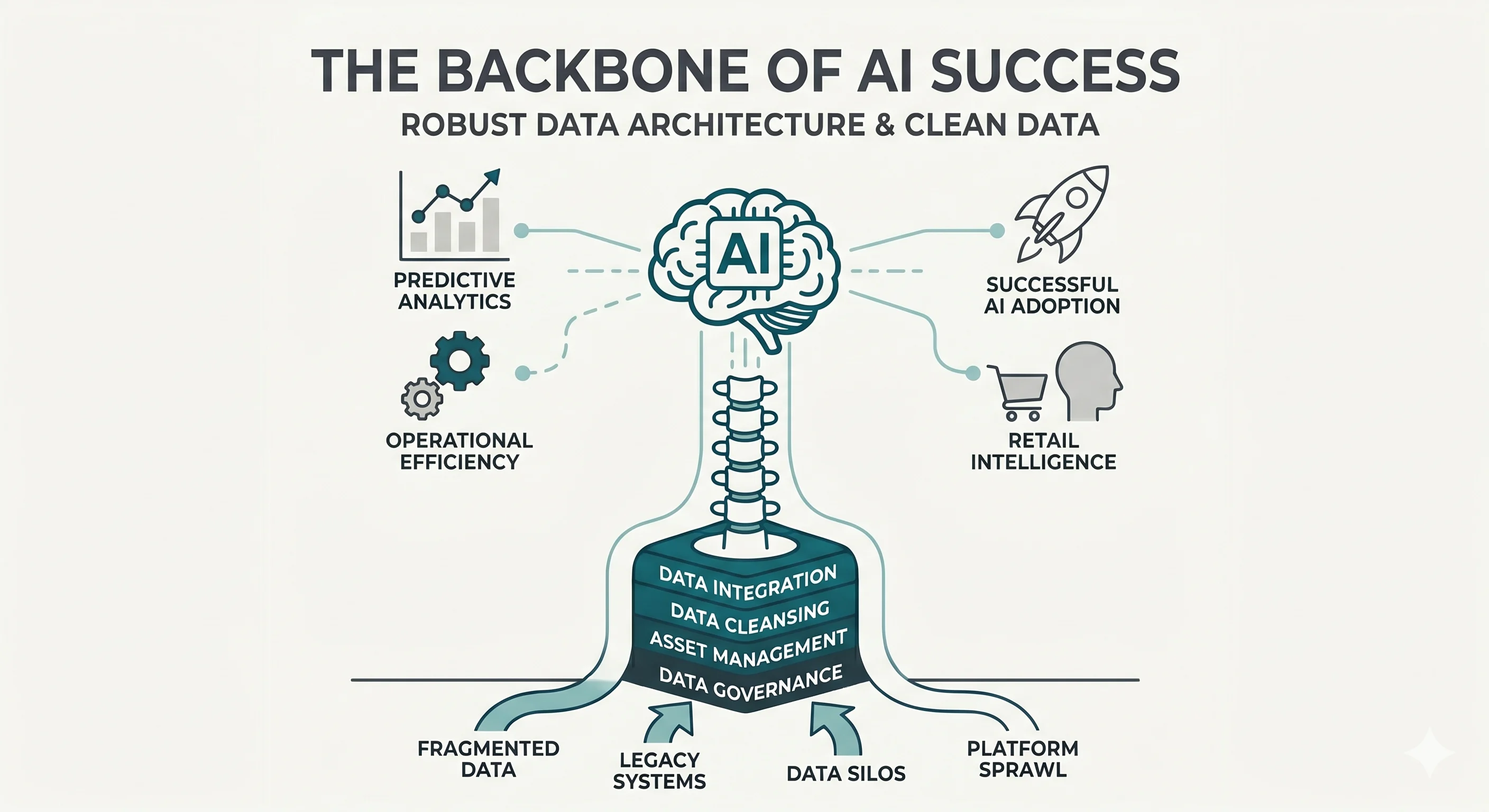
Organizations frequently misdiagnose their AI struggles. When models underperform or vendor solutions fail to deliver expected results, leadership teams often assume they've chosen the wrong technology or partner. The reality is more fundamental: most AI initiatives fail not because of inadequate algorithms, but because of poor data architecture. Without a solid foundation, even the most sophisticated AI systems cannot function reliably.
AI does not remove enterprise data messiness—it magnifies it. Machine learning models require consistent, high-quality data inputs to generate accurate predictions. When data quality is compromised, when data estates are fragmented across multiple systems, or when platform sprawl creates silos, AI initiatives become unstable and untrusted. These foundational issues manifest as model drift, inconsistent outputs, and predictions that business users cannot rely on for decision-making.
The economic implications are significant. Investing in AI pilots before diagnosing the underlying information ecosystem leads to economically inefficient systems. Organizations pour resources into proof-of-concepts and vendor evaluations while the real bottleneck—fragmented data architecture—remains unaddressed. This approach wastes budget, extends timelines, and ultimately undermines confidence in AI adoption across the enterprise.
Data architecture establishes the governance, integration patterns, and quality standards that enable AI to function at scale. A well-designed architecture ensures data lineage is traceable, data quality is measured and maintained, and data access is both secure and efficient. These capabilities are not optional enhancements—they are prerequisites for any AI system that will operate in production environments and support critical business decisions.
The Critical Role of Asset Management in AI Readiness
Asset management extends beyond traditional IT inventory tracking to encompass the entire data ecosystem that AI systems depend upon. Understanding what data assets exist, where they reside, how they're accessed, and who owns them is essential for AI readiness. Organizations that lack comprehensive asset management struggle to identify the right data sources for training models, leading to incomplete or biased datasets that compromise AI effectiveness.
Strategic asset management creates visibility into data dependencies and relationships. When organizations map their data assets comprehensively, they can identify redundancies, gaps, and quality issues before investing in AI capabilities. This visibility prevents the common scenario where AI teams discover mid-project that critical data is unavailable, inaccessible, or incompatible with their requirements.
Regulatory compliance and risk management depend on rigorous asset management. Financial services, healthcare, and insurance organizations face strict requirements under SEC, FINRA, HIPAA, and GDPR regulations. AI systems that process sensitive data must demonstrate clear data lineage, access controls, and audit trails. Without comprehensive asset management, organizations cannot prove compliance or manage the risk of data breaches and regulatory violations.
Asset management also enables cost optimization. When organizations understand their complete data estate, they can consolidate redundant systems, retire obsolete platforms, and optimize storage and compute resources. This rationalization reduces the operational complexity that often undermines AI initiatives and creates a more efficient foundation for scaling AI capabilities across the enterprise.
Building a Unified Data Foundation for Retail Intelligence
Retail organizations face unique data architecture challenges that directly impact AI readiness. Customer data resides in point-of-sale systems, e-commerce platforms, loyalty programs, and marketing automation tools. Inventory data spans warehouse management systems, supply chain platforms, and vendor portals. Financial data lives in ERP systems. This fragmentation prevents the unified view necessary for predictive analytics and intelligent operations.
Building a unified data foundation requires more than technical integration—it demands strategic alignment on data standards, governance policies, and ownership models. Retail organizations must establish common definitions for critical entities like customers, products, and transactions. Without this semantic consistency, AI models trained on data from one system will produce unreliable results when applied to data from another.
Real-time data analytics capabilities depend on architectural choices made during foundation-building. Retail use cases like dynamic pricing, demand forecasting, and personalized recommendations require low-latency access to current data. Organizations must design their data architecture to support both batch processing for historical analysis and streaming capabilities for real-time intelligence. This dual-mode architecture enables the full spectrum of AI-powered retail applications.
Cloud migration plays a strategic role in unifying fragmented data estates. Modern cloud platforms provide the integration services, data quality tools, and governance frameworks that retail organizations need to consolidate their data landscape. However, migration without architectural planning simply moves the problem to a new environment. Organizations must use cloud adoption as an opportunity to redesign their data architecture around AI readiness principles rather than replicating existing fragmentation in cloud infrastructure.
Overcoming Legacy System Challenges in AI Transformation
Legacy systems present significant obstacles to AI adoption, not because the systems themselves are incompatible with AI, but because they embody decades of accumulated technical debt and architectural complexity. Mainframe applications, custom-built databases, and proprietary data formats create integration challenges that make accessing data for AI purposes expensive and time-consuming. These systems often lack APIs, use outdated protocols, and require specialized expertise that is increasingly difficult to find.
The temptation to ignore legacy systems and build AI capabilities on newer platforms is strong but strategically flawed. Legacy systems often contain the most valuable historical data—decades of transactions, customer interactions, and operational patterns that are essential for training robust AI models. Organizations that fail to incorporate legacy data into their AI initiatives build models with incomplete context, reducing accuracy and limiting business value.
Modernization strategies must balance pragmatism with transformation goals. Rather than attempting wholesale replacement of legacy systems—an approach that carries high risk and extended timelines—organizations should focus on creating abstraction layers that make legacy data accessible to modern AI platforms. Data virtualization, API gateways, and event-driven architectures enable AI systems to consume legacy data without requiring complete system rewrites.
Partnering with experienced technology teams accelerates legacy system integration. Organizations that lack in-house expertise in legacy technologies benefit from accessing specialists who understand both older systems and modern AI platforms. This expertise bridges the gap between legacy and modern architectures, enabling faster progress on AI initiatives while managing risk and controlling costs. The right partners bring not just technical skills but also patterns and practices proven across multiple integration scenarios.
Measuring ROI Through Strategic Data and Asset Governance
Measuring ROI on data architecture and asset management investments requires connecting foundational work to business outcomes. Organizations cannot directly observe revenue generated by improved data quality or cost savings from consolidated platforms. Instead, they must establish metrics that link data governance maturity to AI performance, operational efficiency, and business results. These metrics include model accuracy improvements, time-to-deployment for new AI capabilities, and reduction in data-related project delays.
Strategic governance frameworks make ROI measurement possible by establishing baseline metrics before transformation begins. Organizations should measure current data quality scores, time required for data access and integration, and frequency of data-related project failures. These baselines provide comparison points that demonstrate the value delivered by architecture and governance improvements. Without baselines, organizations struggle to prove the business case for continued investment in foundational capabilities.
Governance also reduces risk, and risk reduction generates measurable value. Organizations that implement comprehensive data governance avoid regulatory penalties, reduce security breach exposure, and minimize the reputational damage associated with AI failures. While these avoided costs are sometimes difficult to quantify precisely, they represent real economic value that justifies governance investments. Compliance audits, security assessments, and AI ethics reviews all become more efficient under strong governance frameworks.
Long-term ROI compounds as organizations build on solid foundations. The initial investment in data architecture and asset management pays dividends across multiple AI initiatives rather than benefiting only a single project. Organizations with mature data capabilities deploy AI faster, scale AI more efficiently, and adapt AI systems to changing business requirements more effectively than those without foundational discipline. This compounding effect transforms data architecture from a cost center into a strategic capability that enables sustained competitive advantage through AI adoption.